

What sailors used to know before they had GRIB files — and still works.
Storms rarely arrive without warning. Air pressure shifts, animals behave differently, the sky shows its hand. The trick is knowing what to look at — and knowing that two or more signs together mean it’s time to act, not wait. Here are nine signs that have been read at sea for centuries.
For the foundations of weather observation at sea, see our companion guide: Reading the Weather at Sea — A Sailor’s Field Guide.
1. A halo around the sun or moon
What it is: Cirrostratus cloud — high, thin, ice crystals refracting the light into a ring.
What it means: The leading edge of a warm front. Rain is likely within 24 hours.
Action: prep wet-weather gear, check anchorage holding, identify shelter.
⚠️ 2. A sudden calm before the storm
What it is: Wind that has been steady for hours suddenly drops. Sails luff. The water glasses over.
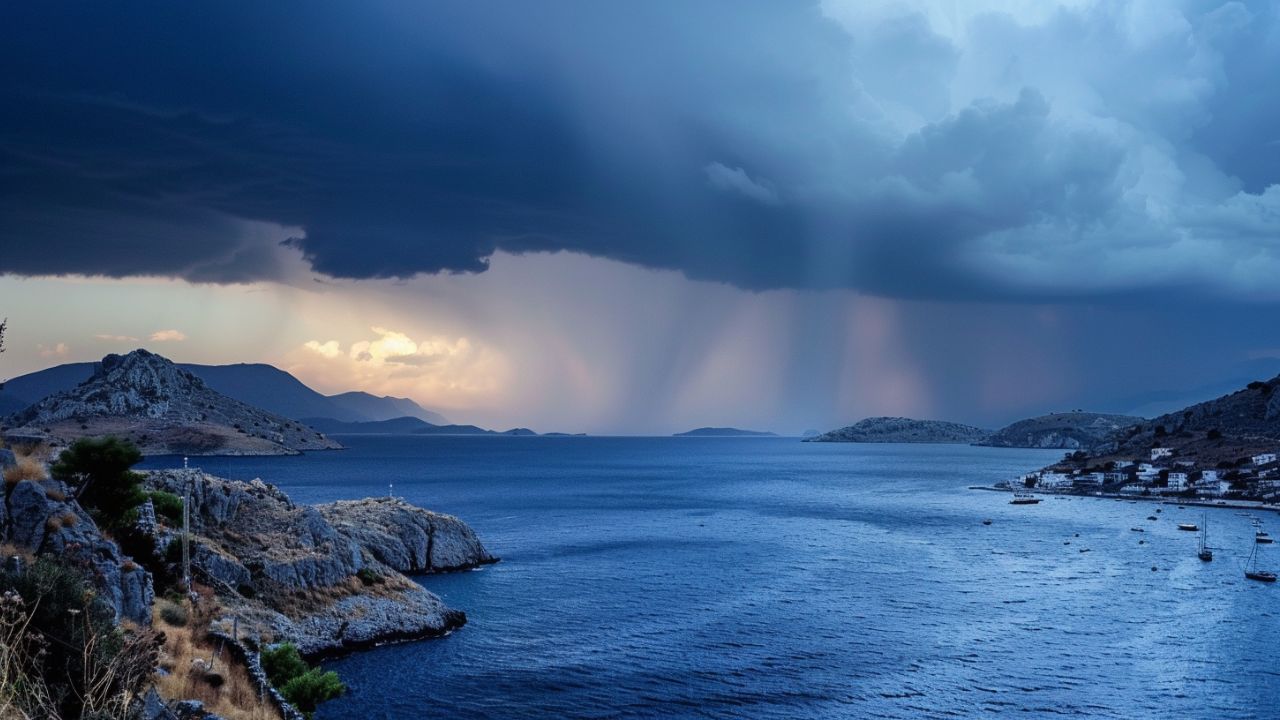
What it means: A major shift is incoming — often a cold front or thunderstorm cell. The calm can last 10 minutes or an hour, then the new wind hits hard.
Action: reef immediately. Don’t wait to see what comes.
⛈️ 3. Cumulonimbus building on the horizon
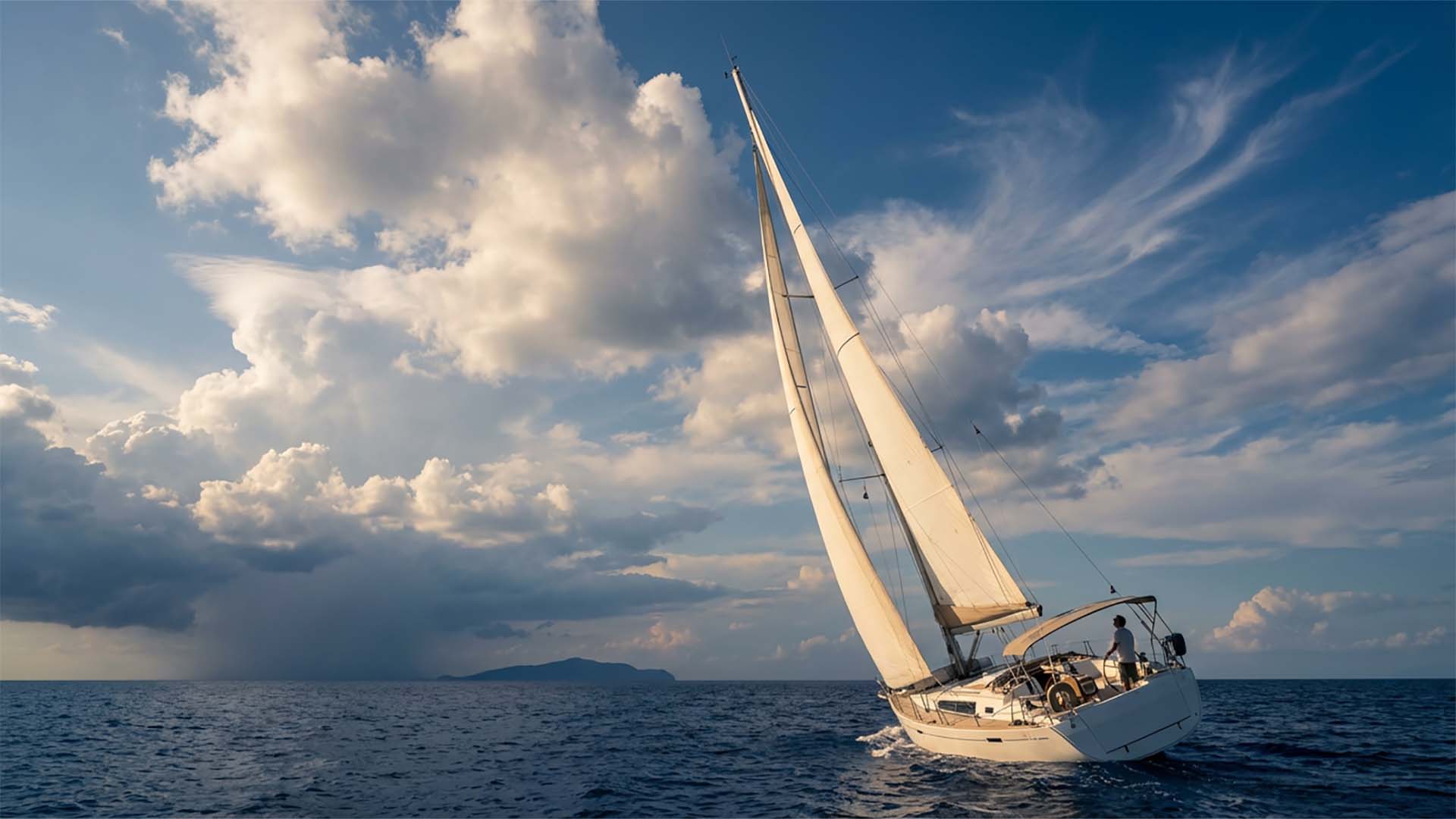
What it is: Tall, dark-based, anvil-topped cloud. Often visible 20–40 miles away.
What it means: Active thunderstorm. Lightning, gusts to 50+ knots, possibly hail. The direction of the anvil tells you where it’s heading.
Action: head away from its track. If you can’t, drop sail, secure everything, get crew below.
4. A rapid drop in barometric pressure
What it is: More than 2 millibars per hour, or 5+ over three hours.
What it means: A storm system is closing in fast. The faster the drop, the more severe it’s likely to be.
Action: secure the boat for severe conditions. Identify the closest hold-out anchorage.
5. Wind shifting from S to W or NW
What it is: A clockwise (veering) wind shift, often within 30 minutes.
What it means: A cold front is passing. Expect a line of squalls along the front, then clearing and colder air behind it.
Action: brace for short, sharp squalls. They usually pass within an hour.
6. Sea gulls grouping on the beach
What it is: Gulls leaving open water and clustering on shore — often unusually still.
What it means: Falling pressure makes flight harder; birds head for shelter before the storm. An old sailor’s sign that’s been observed for centuries.
Action: cross-check with other signs. If your barometer agrees, take it seriously.
☁️ 7. Cirrus thickening into altostratus
What it is: Wispy high clouds slowly merging into a continuous milky sheet over a few hours.
What it means: A textbook warm-front sequence. Steady rain typically follows in 6 to 12 hours.
Action: time of day matters — if this happens in the afternoon, you’ll be sailing into rain by dusk.
8. A red sky at dawn
What it is: The eastern sun lighting moisture-laden air arriving from the west.
What it means: Bad weather is approaching from the west. The old rhyme “red sky at morning, sailor’s warning” has solid physics behind it.
Action: don’t start a long passage. If you must, plan a bail-out point.
9. Sound carrying unusually far
What it is: Distant church bells, car engines, voices from another anchorage — clearer than usual.
What it means: Humidity is rising and pressure is dropping. Sound waves bend differently in moist, low-pressure air.
Action: check the barometer. If it’s falling, the storm is closer than you think.
The Rule of Two
Any single sign can mislead. Two or more together — for example, a halo overhead and a falling barometer — is the threshold for action.
Don’t wait for the third.
⛵ Know Your Shelter Before You Need It
Every SeaTV visual pilot includes a closest-shelter analysis — bays that hold in different wind directions, where to anchor, what to avoid. Whether you’re sailing the Sporades, Sardinia, or anywhere across the Mediterranean — knowing your bail-out anchorage before the weather turns is the difference between a story and a problem.
Browse all cruising areas on seatv.world
More from this series: Reading the Weather at Sea · The Beaufort Scale at Sea (coming soon).








Leave a Reply